Boss Battles for Everyone: How Developers Are Cracking the Accessibility Code Without Killing the Thrill
There's a moment every gamer knows. You've died seventeen times to the same boss. Your thumbs hurt. Your patience is gone. And somewhere in the back of your head, a voice whispers: maybe this game just isn't for me.
For a long time, that voice had a point. Boss battles — the dramatic, high-stakes encounters that define action games — were designed with a specific player in mind. Fast reflexes. Hours of free time. A high tolerance for punishment. If you didn't fit that mold, you were often just out of luck.
But something has shifted in game design over the last few years. Developers are rethinking what it means to make a boss fight hard — and more importantly, who gets to experience the payoff when it's finally over.
The Old Wall and Who It Kept Out
Classic boss design philosophy was pretty simple: here's a threat, here are the rules, figure it out or don't. Games like Dark Souls built entire identities around that uncompromising stance. And honestly? There's real artistry in that approach. The difficulty wasn't arbitrary — it was the point.
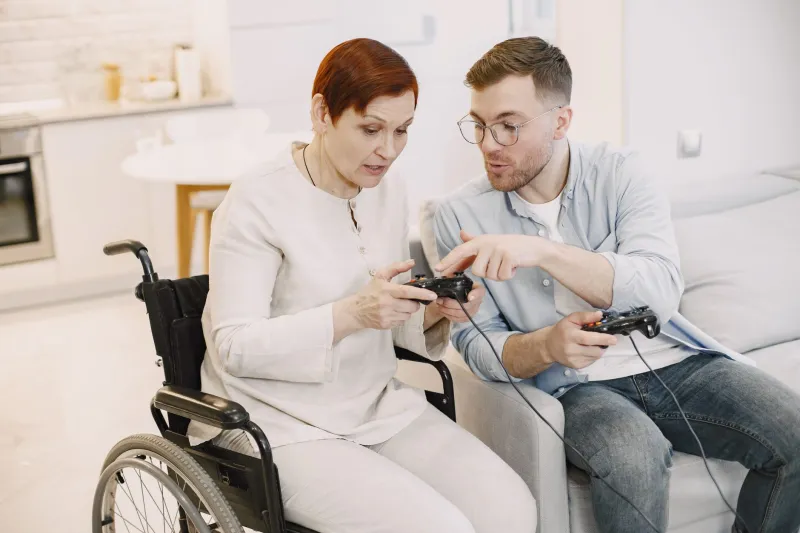
But that philosophy had a cost. Players with motor disabilities, visual impairments, cognitive differences, or even just less gaming experience were systematically excluded from some of the most celebrated moments in the medium. That's not a small group. According to the AbleGamers Charity, roughly 46 million Americans with disabilities play video games. Add casual players and folks returning to gaming after years away, and you're talking about a massive chunk of the audience that boss-heavy games were quietly turning away.
The frustrating part? Most of those players wanted to be there. They wanted to feel the rush of finally beating a monster that had been destroying them for an hour. The desire was there. The access wasn't.
What Accessibility Actually Looks Like in 2025
Modern accessibility in boss design isn't one single thing — it's a toolkit, and the best developers are learning to use the whole set.
Assist modes are probably the most talked-about option. Celeste popularized the concept back in 2018, letting players slow down the game, add invincibility, or skip sections entirely — all without judgment or penalty. The genius of that system was framing: the game never called it "easy mode." It called it your mode. That reframing mattered enormously to players who'd been conditioned to see difficulty adjustments as admissions of failure.
More recent titles have taken that idea further. Star Wars Jedi: Survivor and God of War Ragnarök both offer granular difficulty sliders that separate enemy aggression, player damage, and parry windows as independent variables. You can crank enemy health down while keeping their attack speed brutal, or vice versa. It's a far cry from the old "Normal / Hard / Nightmare" dropdown.
Then there's adaptive mechanics — design choices baked into the encounter itself rather than bolted on in a settings menu. Some games now use dynamic difficulty adjustment (DDA) systems that subtly tune boss behavior based on how a player is performing. Die three times in a row? The boss's attack frequency might quietly decrease. Breeze through the first phase? Expect the second phase to hit harder. The player might not even notice it's happening. The experience just feels more manageable.
Visual and audio accessibility is another huge frontier. High-contrast modes, colorblind settings, and customizable UI scaling all affect how readable a boss fight is under pressure. Some studios are now designing boss attack telegraphs with both visual and audio cues simultaneously, so players who can't rely on one sense can lean on the other.
Does Easier Still Feel Like a Win?
Here's the question that splits the community every single time this topic comes up: if the boss is more forgiving, does beating it actually mean anything?
It's a fair tension to acknowledge. Part of what makes dropping a legendary boss feel so good is the resistance — the sense that the game pushed back hard and you pushed harder. Strip that away entirely, and you might be left with something that feels hollow.
But here's the thing: accessibility options don't erase difficulty for anyone who doesn't want them erased. A player who turns on invincibility and clears a boss in one try isn't taking anything away from the player who grinds through 40 attempts on default settings. Both of those people got something real out of the experience — they just got different things.
What's more interesting is what players with disabilities actually report about these systems. Many accessibility advocates push back hard against the idea that easier automatically means less satisfying. A player who's been locked out of an entire genre for years and finally gets to experience a boss fight's story payoff — the cutscene, the narrative resolution, the sense of progression — often describes that moment with exactly the same emotional weight as a hardcore player describing their first Elden Ring clear. The victory feeling is real. The path to it just looked different.
Where Developers Are Still Falling Short
For all the progress, the industry isn't there yet. Accessibility features are still treated as add-ons in too many studios — something tacked on late in development rather than designed from the ground up. When that happens, the options feel clunky or incomplete. A game might have a "story mode" difficulty that makes regular combat a breeze but does nothing to address the visual chaos of a multi-phase boss with screen-filling particle effects.
Remapping controls — one of the most universally useful accessibility tools — is still missing from a surprising number of major releases. For players who use adaptive controllers or non-standard input setups, that absence can make an otherwise accessible game completely unplayable at the exact moment it matters most: the final boss.
There's also a discoverability problem. Accessibility menus are often buried, labeled vaguely, or presented in ways that feel stigmatizing. If a player has to dig through five submenus to find the option that makes the game playable for them, that's a design failure, full stop.
The Bigger Picture for Boss Design
What's genuinely exciting about this moment in game design is that accessibility and challenge aren't actually opposites. The studios doing this best — Naughty Dog, Insomniac, FromSoftware in its own way — are proving that you can build a boss encounter with serious teeth and still give players meaningful agency over how they engage with it.
Dropping a boss should feel legendary. That feeling isn't the exclusive property of players who clear it on the hardest setting with no assists. It belongs to the player who spent months building up the courage to try an action game for the first time. It belongs to the player who finally figured out the right control setup that works with their disability. It belongs to anyone who showed up, kept trying, and got there.
The goal was never to make boss fights easy. It was to make the win available to more people. And slowly, finally, the industry is starting to figure out how to do exactly that.